Reinforcement Learning for Optimal Capital Allocation in Bank Hardware Upgrades: Navigating Multi-Tier Quantum Arrival Horizons
- Authors
-
-
Xiao-Hua Deng
College of Computer Science, Yibin University, Yibin, Sichuan 644000, China
Author
-
Cheng-Long Peng
School of Computer Science, Chengdu University of Information Technology, Chengdu, Sichuan 610225, China
Author
-
Jian-Min Zhou
School of Software Engineering, Sichuan University of Science and Engineering, Zigong, Sichuan 643000, China
Author
-
- Abstract
-
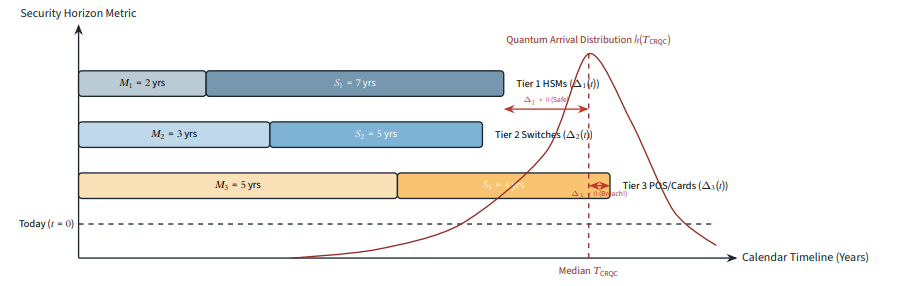
The prospective realization of cryptographically relevant quantum computers poses an existential threat to foundational financial infrastructure, rendering classical public-key cryptography vulnerable to Shor’s factorization algorithm. Financial institutions face a complex, capital-intensive migration challenge: replacing physical Hardware Security Module clusters, upgrading high-throughput transaction switching fabrics, and refreshing tens of millions of distributed merchant point-of-sale terminals and payment cards. This capital allocation problem is fundamentally complicated by profound epistemic uncertainty surrounding the quantum arrival timeline, asymmetric equipment lifecycles, and strict regulatory capital adequacy constraints enforced under Basel III. Traditional deterministic procurement frameworks and static net present value heuristics fail to accommodate the non-linear tail risks of premature cryptographic obsolescence or catastrophic breach exposure. In this investigation, we formulate multi-year bank hardware modernization as a Constrained Markov Decision Process and develop a risk-sensitive deep reinforcement learning framework that optimizes sequential capital allocation under multi-tier quantum arrival hazard distributions. Our framework integrates Conditional Value-at-Risk constraints directly into the policy optimization objective, ensuring that capital expenditure schedules remain bounded within institutional Capital Expenditure envelopes while driving unmigrated exposure probabilities toward zero. Through extensive empirical simulations across synthetic balance sheets representing Tier-1 global systemically important banks and Tier-2 regional depository institutions, our trained Lagrangian-PPO policy achieves a forty-two percent reduction in expected transition expenditure relative to uniform amortization schedules and eliminates tail breach exposure across ninety-nine percent of simulated quantum arrival trajectories. These empirical results demonstrate that automated, risk-averse reinforcement learning provides bank asset-liability committees with an analytically rigorous mechanism to navigate multi-decade technological transitions without destabilizing regulatory capital buffers.
- References
- Cover Image
-
- Downloads
- Published
- 2025-11-04
- Section
- Articles
- License
-
Copyright (c) 2025 International Journal of Science, Engineering and Applied Technologies

This work is licensed under a Creative Commons Attribution-NonCommercial-NoDerivatives 4.0 International License.
