Real-Time Kick State Estimation from Sparse Surface Measurements via Thermodynamic Reduced-Order Modeling and Bayesian Data Assimilation
- Authors
-
-
Hammad Raza
Kohat University of Science and Technology, Bannu Road No. 14, Kohat, Khyber Pakhtunkhwa, Pakistan
Author
-
Saad Mehmood
University of Turbat, Gwadar Highway No. 7, Turbat, Balochistan, Pakistan
Author
-
Usman Qureshi
Gulzar-e-Quaid Block 4, Lahore, Punjab, Pakistan
Author
-
- Abstract
-
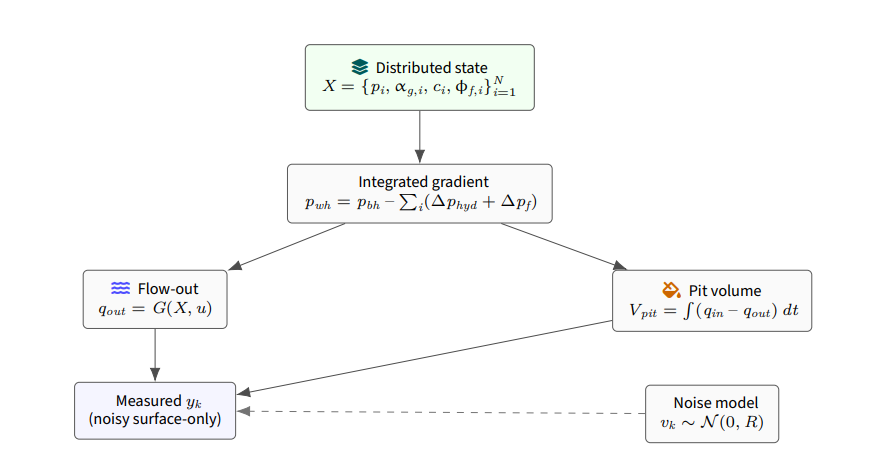
Drilling operations routinely encounter uncertain pore-pressure environments in which a narrow margin separates stable overbalanced circulation from an underbalanced influx event. Because downhole instrumentation is often limited, operational decisions are frequently made using sparse surface measurements such as standpipe pressure, choke pressure, flow-out, and pit volume. These signals are informative but non-unique, since multiple downhole states can map to similar surface responses when compressibility, slip, friction, and transient boundary conditions interact. This paper presents a technical framework for real-time kick characterization and control that couples a thermodynamic two-phase annular flow model with a reduced-order discretization and a Bayesian data assimilation layer tailored to surface-only observability. The core contribution is an inference-stable state-space formulation that explicitly represents free-gas migration, dissolution and exsolution in non-aqueous fluids, and pressure-loss evolution under dynamic actuation, while remaining computationally tractable for online use. A sequential ensemble-based estimator reconstructs latent influx parameters such as entry depth, influx rate history, and gas holdup distribution from noisy surface streams, and propagates calibrated uncertainty into a decision module that selects backpressure trajectories consistent with operational constraints. The method is evaluated through numerical experiments spanning circulating and shut-in transients, heterogeneous frictional regimes, and solubility-sensitive mud systems. Results indicate that the proposed approach reduces detection latency while providing physically interpretable posterior distributions for influx size and location, enabling risk-aware well-control actions without requiring dense downhole sensing.
- References
- Cover Image
-
- Downloads
- Published
- 2025-07-04
- Section
- Articles
- License
-
Copyright (c) 2025 International Journal of Science, Engineering and Applied Technologies

This work is licensed under a Creative Commons Attribution-NonCommercial-NoDerivatives 4.0 International License.
