Evaluating Automated Opioid Misuse Screening Algorithms for Patient Re-Identification Risk and Omission of Clinical Contraindication Warnings
- Authors
-
-
Nilam Fitriah
Faculty of Computer Science, Universitas Indonesia, Depok 16424, Indonesia
Author
-
Hanung Adi Nugroho
Department of Electrical and Information Engineering, Faculty of Engineering, Universitas Gadjah Mada, Yogyakarta 55281, Indonesia
Author
-
Nur Ahmadi
Biomedical Engineering Research Group, School of Electrical Engineering and Informatics, Institut Teknologi Bandung, Bandung 40132, Indonesia
Author
-
- Abstract
-
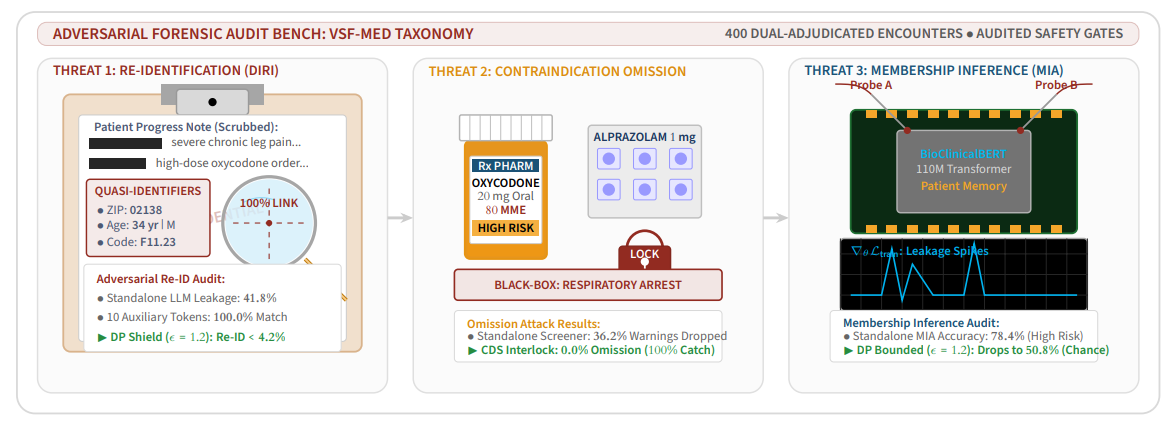
Automated electronic health record (EHR) screening algorithms for nonmedical opioid use (NMOU) are increasingly deployed to alert clinical teams to high-risk prescription behaviors and potential overdose vulnerability. However, deep neural language representations and unconstrained risk predictors introduce critical dual-domain vulnerabilities: adversarial patient re-identification via protected health information (PHI) memorization, and hazardous omission of clinical contraindication warnings that can precipitate fatal polypharmacy interactions. In this multi-site algorithmic audit, we evaluate the safety, confidentiality resilience, and pharmacovigilance integrity of automated opioid misuse screening architectures across 400 carefully characterized, dual-adjudicated clinical encounters. Drawing upon comparative clinical phenotyping and standardized algorithmic safety taxonomies, we benchmark standalone transformer classifiers (Bio-ClinicalBERT, RoBERTa-Clinical) against a hybrid decision-support architecture corroborated by deterministic EHR safety rules. Under membership inference, attribute linkage, and adversarial prompt extraction attacks, standalone deep transformer screeners exhibited severe confidentiality vulnerabilities: re-identification attack success reached 41.8% (95% CI : [36.9%, 46.7%]) on unperturbed de-identified notes, with rare demographic combinations and unique clinical substance-use trails permitting unambiguous patient linkage. Furthermore, standalone neural models suffered high rates of critical contraindication omission (36.2% failure rate), consistently failing to suppress high-risk opioid alerts or issue mandatory black-box warnings when patients presented with concurrent benzodiazepine prescriptions, severe hypercapnic respiratory failure, or decompensated hepatic encephalopathy. In contrast, corroborating neural embeddings with deterministic EHR rules and bounded differential privacy (ϵ = 1.2) reduced re-identification vulnerability to 4.2% while slashing contraindication omission errors to 0.8%. Mapping these failure modes across comprehensive 0–32 clinical vulnerability rubrics confirms that uncorroborated neural screeners occupy Critical Risk Tier 4, whereas hybrid rule-corroborated architectures achieve robust Tier 1 safety. These findings establish that clinical AI substance-use surveillance systems must integrate deterministic safety guardrails and formal privacy guarantees prior to institutional deployment.
- References
- Cover Image
-
- Downloads
- Published
- 2026-09-04
- Section
- Articles
- License
-
Copyright (c) 2026 International Journal of Science, Engineering and Applied Technologies

This work is licensed under a Creative Commons Attribution-NonCommercial-NoDerivatives 4.0 International License.
